
The way we interact with technology is fundamentally changing. While the past decade was about reactive systems, waiting for human input, the next wave will be led by proactive agents: AI systems that don’t just respond, but anticipate and act on behalf of users.
Imagine an AI that reorders your groceries when they run low, books your travel before prices surge, or negotiates better insurance terms without you lifting a finger. That’s the power of proactive agents and they’re closer than you think.
In this article, we’ll break down what proactive AI agents are, how they’re evolving, real-world use cases, and how brands can get ready to serve and convert these digital decision-makers into high-value customers.
What Are Proactive AI Agents?
Proactive agents are autonomous AI systems that initiate actions without waiting for explicit instructions. Unlike traditional bots that require a question or command, proactive agents observe context, interpret intent, and act based on learned preferences or predefined goals.
They combine multiple capabilities:
- Contextual awareness (via sensors, APIs, or user behavior)
- Goal orientation (they know what the user wants)
- Autonomous execution (they take action with or without real-time supervision)

Think of them as digital personal assistants with initiative, capable of:
- Watching your needs
- Predicting your next step
- Taking action for you
This shift from reactive to proactive marks a massive change in how products, services, and businesses are discovered and used.
When Will Proactive Agents Become a Reality?
We’re already seeing the early signals:
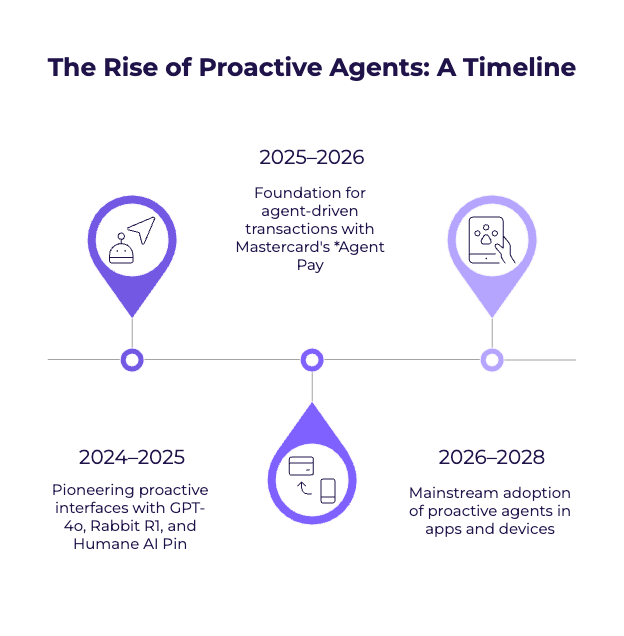
- 2024–2025: Tools like OpenAI’s GPT-4o, Rabbit R1, and the Humane AI Pin are pioneering proactive interfaces.
- 2025–2026: Platforms like Mastercard’s Agent Pay are laying the foundation for agent-driven transactions.
- 2026–2028: Proactive agents are expected to be embedded into everyday apps, devices, and virtual assistants, becoming mainstream in consumer and enterprise settings.

While full autonomy in critical areas like healthcare or finance will take time, expect proactive agents to play an increasing role in shopping, support, scheduling, and optimization tasks over the next 1–2 years.
Use Cases: How Proactive Agents Will Reshape Customer Journeys
E-commerce Replenishment
A proactive agent notices you’re out of pet food, finds the best deal, applies your usual discount code, and completes the purchase — before you even realize you’re low.
Travel Booking
The agent monitors your calendar, anticipates a business trip, tracks airfare, books at the optimal time, and checks you in automatically.
Smart Home & Energy
An AI system adjusts lighting, appliances, and thermostat settings based on your routine and energy prices, minimizing cost and waste.
Financial Optimization
Your agent shifts idle money to high-interest accounts, negotiates credit card fees, and alerts you to better mortgage offers.
Healthcare Reminders & Scheduling
It books follow-ups, reminds you to take medications, refills prescriptions, and rearranges appointments based on your availability.
In each scenario, the agent acts before the user, driving outcomes that benefit both the consumer and the brand.
How Brands Can Prepare for Proactive Agents
Serving proactive agents requires a fundamental shift in digital strategy. You’re not just designing for humans anymore — you’re designing for AI as a customer.
Expose Machine-Readable Data
Proactive agents need clean, structured data. Brands must invest in:
- Product feeds with real-time pricing and availability
- Rich metadata (via Schema.org or JSON-LD)
- Clear policies (shipping, return, refund) in machine-readable formats
Enable Agentic Payment Checkout
Proactive agents will rely on secure, API-first agentic payment systems like:
- Mastercard Agent Pay
- Tokenized payment gateways
- One-click purchase protocols that work agent-to-agent
Monitor AI Traffic
Traditional analytics tools miss AI interactions. Use specialized tools to:
- Detect visits from LLMs (ChatGPT, Perplexity, Claude, etc.)
- Track AI-driven link previews, summaries, and citations
- Measure AI-driven conversions and attribution
Redefine Trust Signals
Agents optimize for reliability, uptime, and terms. Ensure your brand surfaces:
- Transparent pricing
- Verified inventory
- High fulfillment rates
- Low return ratios
Create Agent-Specific Experiences
Consider building:
- Agent-facing APIs
- AI-friendly landing pages (e.g.,
ai.brand.com) - Lightweight documentation for agent use (API keys, permissions)
Brands that treat proactive agents as a new kind of user persona will be ahead of the curve — and gain a first-mover advantage in AI-powered commerce.
How to turn Proactive Agents into Loyal Customers
Proactive agents are not a far-off future, they’re arriving through new devices, LLM platforms, and commerce rails as we speak. As they gain autonomy, they’ll redefine what “customer journey” means.
Brands that adapt early will:
- Win conversions without human clicks
- Reduce customer churn through auto-renewals and predictive service
- Unlock new automation-led revenue streams
Whether you’re a D2C brand, SaaS provider, or marketplace, now is the time to prepare your business for proactive agents.
Because in a world where machines make decisions, your real customer might not be a person; it might be an AI.